Global stocks rise ahead of bank earnings as Treasury yields edge higher
The S&P 500 and Nasdaq gained about 0.6%, while the benchmark U.S. 10-year Treasury yield rose to 5.261%.

South Korean stocks fell 1.1%, while U.S. equity futures rose ahead of bank earnings. Brent crude slipped to $103.50 a barrel.
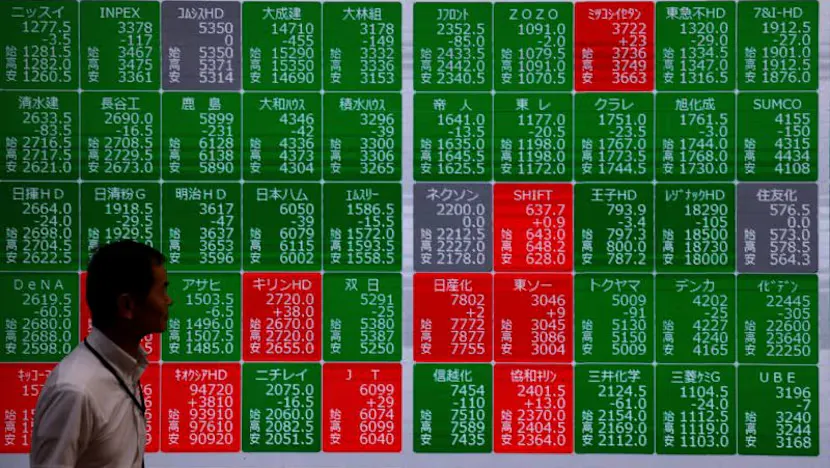
Asian equities opened cautiously on October 12 ahead of the U.S. earnings season, with South Korean shares down 1.1% and MSCI's broad Asia-Pacific gauge excluding Japan largely unchanged. Oil futures declined after initially rising amid strikes targeting Gulf shipping and airports.
Brent dropped 1.1% to $103.50 a barrel, below its recent peak of $109.97. U.S. crude fell 1.2% to $90.73 a barrel. Neither Ukraine nor Russia had confirmed President Donald Trump's announced energy ceasefire between the two countries.
U.S. stock futures advanced, with contracts on the S&P 500 up 0.2% and those on the Nasdaq gaining 0.5%. EUROSTOXX 50 and DAX futures each rose 0.4%, while FTSE futures added 0.3%. Trading was thin as Japanese markets were closed and the United States observed a partial holiday.
Major U.S. banks were due to begin reporting earnings on Tuesday. LSEG IBES estimates pointed to third-quarter S&P 500 earnings growth exceeding 30%, largely driven by technology companies.
AMP economist My Bui said technology accounted for all S&P 500 gains since mid-September, while investors were seeking higher yields to finance AI borrowing. Bui said widening credit spreads suggested doubts about whether AI revenue could keep up with increasing borrowing costs.
The dollar index stood at 102.25, close to a 17-month high, while the euro traded at $1.1201 after five consecutive weekly declines. Gold gained 0.3% to $4,206 an ounce.