Oil prices decline as investors assess sanctions relief and shipping attacks
Brent dropped to $104.67 a barrel as Washington considered allowing sanctioned vessels to transport legally traded oil.

The country plans competitive bidding for future power projects as it seeks investment to serve rising industrial and data-center demand.
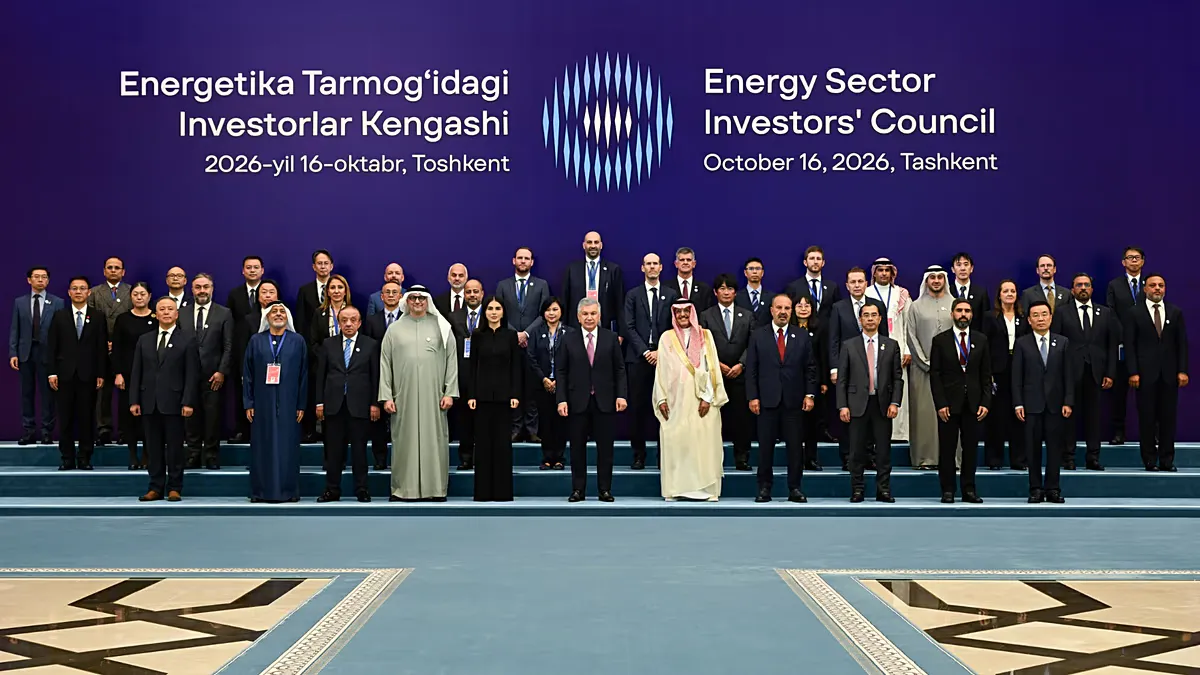
Six energy agreements signed in Tashkent carry a combined value of $4.7 billion, Uzbekistan’s presidency said. President Shavkat Mirziyoyev also set out ambitions for two more nuclear facilities as the country seeks foreign capital to supply growing electricity needs from industry and data centers.
The package provides for 3,000 MW of additional generation and 400 MW of storage, according to the presidency. A separate bidding process will cover six wind and solar developments totaling 2,200 MW.
Mirziyoyev said competitive tenders would govern future projects, with developers informed beforehand about grid connections and electricity-purchase conditions. He acknowledged that developer-led site selection had clustered plants in certain areas while making transmission more costly elsewhere. A national energy master plan extending to 2050 is due by July 2027.
The government’s 2030 goals call for 22 GW of additional generating capacity, 16 new substations and 5,000 kilometers of power lines, alongside storage capacity reaching 4.5 GW. The presidency expects renewables, with hydropower included, to provide 54% of generation, against 31% currently.
Details of the proposed second and third nuclear plants remain undisclosed, including their partners, budgets and schedules. Work on Uzbekistan’s first nuclear facility started in June in Jizzakh, with Russia’s Rosatom involved in its development.
That facility would have 2,110 MW of capacity across four reactors: two large and two smaller units. Costs are estimated at up to $9.5 billion. Initial technical commissioning is scheduled for 2029, while completion is planned for 2034–2035.
Mirziyoyev also acknowledged bureaucracy and corruption as continuing investment obstacles. Saida Mirziyoyeva, who heads the Presidential Administration, will chair a new Energy Investors’ Council tasked with addressing difficulties such as obtaining land and connecting projects to the grid.